
How to Tell If Your Crypto Assets Are Really Lost
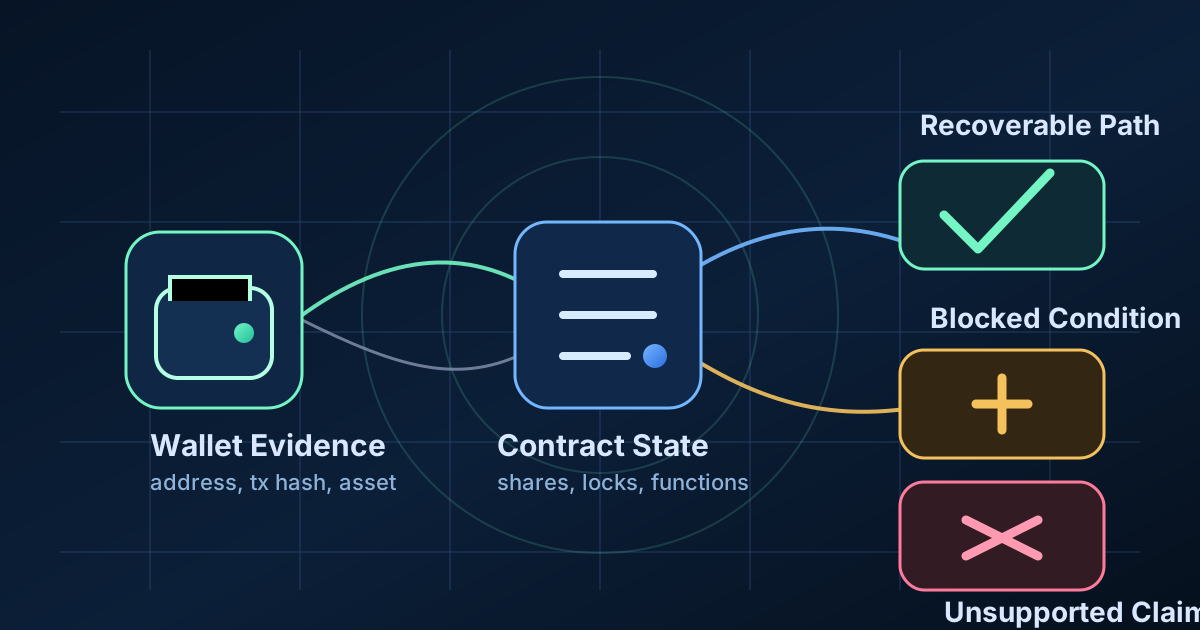
Summary: A crypto asset can look gone long before it is actually gone. A missing dashboard balance may point to a broken interface, a contract-state condition, a position-token mismatch, or a genuine loss. The first step is structured on-chain analysis.
In DeFi, an asset can look gone long before it is actually gone. A withdrawal page may stop loading. A protocol website may disappear. A dashboard may show zero balance even though earlier transactions clearly moved value into a contract. A bridge may show a pending state for too long. A staking interface may fail after the project team stops maintaining the front end.
These situations are stressful because users often cannot tell the difference between three very different outcomes: the asset is still controlled by a smart contract but the user interface is broken, the asset is technically accessible but requires direct contract review, or the asset is no longer recoverable because the underlying contract state or balance has changed.
Understanding the difference matters. Acting too quickly can create unnecessary risk. Waiting without analysis can also make the problem harder to understand. The right first step is not panic. It is structured on-chain analysis.
Lost Is Not a Technical Diagnosis
In everyday language, users often say their funds are lost when they cannot access them. On-chain, that word is too vague. Blockchain systems do not think in terms of feelings, support tickets, or dashboard messages. They track balances, ownership records, contract storage, permissions, transaction history, and callable functions.
If an asset appears missing, the important question is not simply where it went. The better question is: what does the chain currently say about the asset?
That answer usually falls into several categories. The asset may still be held by a contract such as a staking pool, vault, vesting contract, bridge, lending market, or liquidity position. The user interface may be gone, but the contract may still exist and may still expose relevant functions.
The asset may also have changed form. A user may no longer hold the original token because it was exchanged for an LP token, a receipt token, a vault share, or another accounting representation. In that case, the original balance may look absent even though the user still has a claim represented elsewhere.
Some assets are locked by design. Time locks, cooldown periods, withdrawal queues, epoch-based accounting, and administrator-controlled states can make assets appear unavailable even when they are following the protocol's intended logic. Other cases involve contract risk: a contract may be paused, drained, misconfigured, upgraded, abandoned, or restricted.
A 10-Minute Triage Check
Before opening random tools or copying another user's transaction, do a short triage pass. The goal is not to recover anything in ten minutes. The goal is to decide whether the next step is explorer review, contract-state review, support documentation, or no-action documentation.
| Question | Useful evidence | What it tells you |
|---|---|---|
| Did the deposit transaction succeed? | Transaction receipt, status, logs, and token transfer events. | If it failed, the asset may never have entered the protocol. |
| Which contract received the asset? | Recipient address, decoded input, emitted events, and known protocol contract labels. | Confirms whether you interacted with the expected contract. |
| Does the wallet still hold a position token or share? | ERC-20/ERC-721/ERC-1155 balances, vault shares, LP tokens, or internal position records. | A missing original token may still map to a valid claim. |
| Does the contract still hold enough underlying assets? | Contract token balance, vault accounting, pool reserves, or bridge escrow balance. | A recorded claim is stronger when the contract still has assets to satisfy it. |
| Have similar exits succeeded recently? | Recent successful withdraw, redeem, claim, exit, or unstake transactions. | Shows whether the path is still operational, but does not prove it fits your address. |
For example, a wallet may show zero USDC after a vault deposit because the wallet now holds vault shares instead of USDC. That is not the same as a drained contract. A stronger review would compare the original deposit transaction, the share balance, the vault's current accounting, and recent redeem transactions. If those four points line up, the case is closer to stuck access than final loss.
Start With the Asset, Chain, and Transaction History
The first useful step is to identify the exact asset and network involved. Many DeFi problems become confusing because users mix up similar token symbols, wrapped assets, bridge representations, or networks. A token on Ethereum is not the same thing as a token with the same symbol on BNB Chain, Polygon, Arbitrum, Base, or another EVM network.
For any stuck asset case, collect the basic public information before assuming the worst.
| Information | Why it matters |
|---|---|
| Blockchain network | Prevents confusion between similar tokens across chains. |
| Asset contract address | Confirms the exact token or position being reviewed. |
| Public wallet address | Identifies the account involved without exposing secrets. |
| Transaction hash | Shows what actually happened on-chain. |
| Receiving protocol contract | Shows where the asset, claim, or position may now be held. |
| Later claim or withdrawal attempts | Helps reconstruct whether state changed after the original deposit. |
The transaction hash is especially important. It shows what actually happened: which address sent value, which contract received it, which function was called, whether the transaction succeeded, and which events were emitted. If the original transaction failed, the asset may never have entered the contract. If it succeeded, the next question is what the contract did with it.
Check Whether the Protocol Interface Is the Problem
A broken website does not always mean a broken contract. Many DeFi protocols rely on web interfaces that read contract data and prepare transaction requests for users. If the project team shuts down the front end, changes domains, loses hosting, breaks an API, or stops updating the interface, users may lose the easiest way to interact with the protocol.
But smart contracts deployed on public chains can continue to exist even after the website is gone. This creates a common situation: the interface is unavailable, but the contract still holds state and may still expose functions. In other words, the access path is broken, not necessarily the asset itself.
- The protocol website is offline, but contract balances remain visible on a block explorer.
- The dashboard shows incorrect information, but the wallet still has related receipt tokens or position records.
- Other users report front-end errors while contract activity continues.
- The contract has callable read functions that still return user-specific balances or positions.
- Historical transactions show withdrawal or claim functions that succeeded before.
This does not automatically mean the asset is recoverable. It means the next step is contract-level review instead of assuming the dashboard is final. For practical evidence collection, compare this article with the block explorer fund-tracking workflow and the Etherscan withdrawal guide.
Understand the Difference Between Balance and Claim
One of the most common DeFi misunderstandings is the difference between holding an asset and having a claim on an asset. When a user deposits tokens into a vault, farm, bridge, or lending protocol, the original token may leave the user's wallet. The protocol may issue a different representation: a share token, LP token, staking record, deposit receipt, or internal balance.
The user's wallet may no longer show the original asset because the contract now controls it according to protocol rules. This is normal in many DeFi designs. The important question becomes: does the user still have a valid claim recorded somewhere?
- A token balance representing a pool share.
- A staking position inside a contract.
- A pending withdrawal record.
- A claimable reward amount.
- A bridge message waiting for completion.
- An event history that confirms participation in a protocol position.
If the claim exists and the contract has a valid execution path, the situation may be recoverable or partially recoverable. If the claim does not exist, or if the contract balance no longer supports the claim, the outlook becomes weaker. This is why analysis usually looks at both sides: the user's position and the contract's available assets.
Review Contract State, Not Just Token Balance
Token balance is only one layer of analysis. In DeFi, the contract state often matters more than a simple balance view. A token may sit inside a contract, but that does not mean every user can withdraw it. The contract logic determines who can call which function, under what conditions, and with what result.
Important contract-level questions include whether the contract still holds the relevant asset, whether the user's address has a recorded balance or position, whether withdrawal or claim functions are available, whether those functions are paused or restricted, whether the contract has been upgraded, and whether recent transactions show other users successfully exiting.
The last question can be useful. If other users recently completed similar actions, the contract may still be operational. If no one has interacted successfully for a long time, deeper review is needed. However, copying another user's transaction without understanding the contract path is risky. DeFi interactions are state-dependent.
Classify the Situation Before Taking Action
A helpful way to think about stuck DeFi assets is to classify the case before attempting any transaction.
| Category | What it means | Next step |
|---|---|---|
| Interface issue, contract likely functional | Website or dashboard is broken, but positions and balances remain visible. | Identify the correct contract interaction path and execution risk. |
| Contract active, conditions unclear | Time locks, cooldowns, paused states, or migrations may apply. | Review conditions before any action changes state. |
| Contract balance exists, user claim uncertain | Assets exist somewhere, but the user's individual claim needs evidence. | Connect transaction history to current contract state. |
| Contract no longer supports the claim | The contract may be drained, disabled, or unable to map the current position to an exit. | Document what happened and avoid speculative signing. |
Red Flags That Require Extra Caution
Some situations deserve more caution than others. Be careful when a website asks for broad signing permissions without explaining the exact action, a support account contacts you first and pushes urgent steps, or a tool claims it can solve any stuck asset without reviewing contract state.
Other red flags include interaction requests that are not tied to a clearly identified function, multiple similar contracts where it is unclear which one holds the position, bridge or migration paths with limited documentation, and guidance that comes only from random comments, copied transactions, or unofficial links.
These signals do not always mean a situation is malicious, but they do mean the user should slow down and verify the path before signing any request. Good recovery analysis is not about speed. It is about reducing uncertainty.
What Responsible Review Looks Like
A responsible review of stuck DeFi assets should be evidence-based and non-custodial. It should rely on public on-chain data, contract behavior, transaction history, and documented protocol logic. It should not require users to surrender account control or share sensitive credentials. It should not promise a result before the contract state is reviewed.
A useful review usually produces a summary of what happened on-chain, the current asset or position status, the contract addresses involved, the likely reason the asset appears inaccessible, whether a potential recovery path exists, and the risks and limitations of any proposed action.
It should also explain what cannot be determined from available data. In DeFi, uncertainty is normal. A trustworthy analysis explains limitations instead of pretending every case has a clean answer. For broader context, read the smart contract recovery boundary guide and the smart contract functions guide.
A Simple Decision Framework
Before concluding that assets are gone, ask five questions:
- Is the relevant asset still visible on-chain?
- Does the user's wallet have a recorded position, share, or claim?
- Does the contract expose a relevant exit, claim, or withdrawal path?
- Are there current contract conditions that block that path?
- Have similar transactions succeeded recently?
If most answers are yes, the asset may be stuck rather than gone. If the asset is visible but the user claim is unclear, the case needs deeper analysis. If the asset is no longer in the contract, the claim is not recorded, and no valid function path exists, the situation may be much harder to resolve.
FAQ
Are crypto assets always lost when a DeFi dashboard shows zero
No. A dashboard can be wrong, offline, or unable to read a position. The first check is what the blockchain says about balances, contract state, position records, and transaction history.
What should I collect before reviewing stuck crypto assets
Collect the network, asset contract address, public wallet address, transaction hash, receiving protocol contract, and any later claim, staking, bridge, migration, or withdrawal transactions.
Can a broken protocol website still leave assets recoverable
Sometimes. A broken interface does not always mean a broken contract. If the contract still holds state, records the user's position, and exposes a valid function path, further review may be useful.
When are stuck DeFi funds harder to recover
Cases become harder when the contract no longer holds the asset, the user's claim is not recorded, the relevant function path is disabled, or later transactions changed the contract state.
Final Thoughts
In DeFi, lost is often the wrong first conclusion. Assets can become hidden behind broken interfaces, inactive protocol websites, complex contract states, expired dashboards, bridge delays, or misunderstood position tokens. Some cases are recoverable. Some are not. Many sit in the middle until someone reviews the chain data carefully.
The safest approach is to slow down, collect public transaction information, verify the asset and network, inspect contract state, and classify the situation before taking action. The goal is not to assume every stuck asset can be recovered. The goal is to understand what the blockchain actually says before making the next decision.
Need a Structured Review of Stuck DeFi Assets
Start with public transaction data, contract addresses, and a clear description of the asset path. Do not submit wallet secrets or sensitive credentials.
Request Case EvaluationReview Recovery Services
A review can explain contract state and risk boundaries. It cannot guarantee that every stuck asset has a valid exit path.

About the Author: Carlos Vendrell
Last updated: