
Can Smart Contracts Recover Assets? What Is Actually Possible
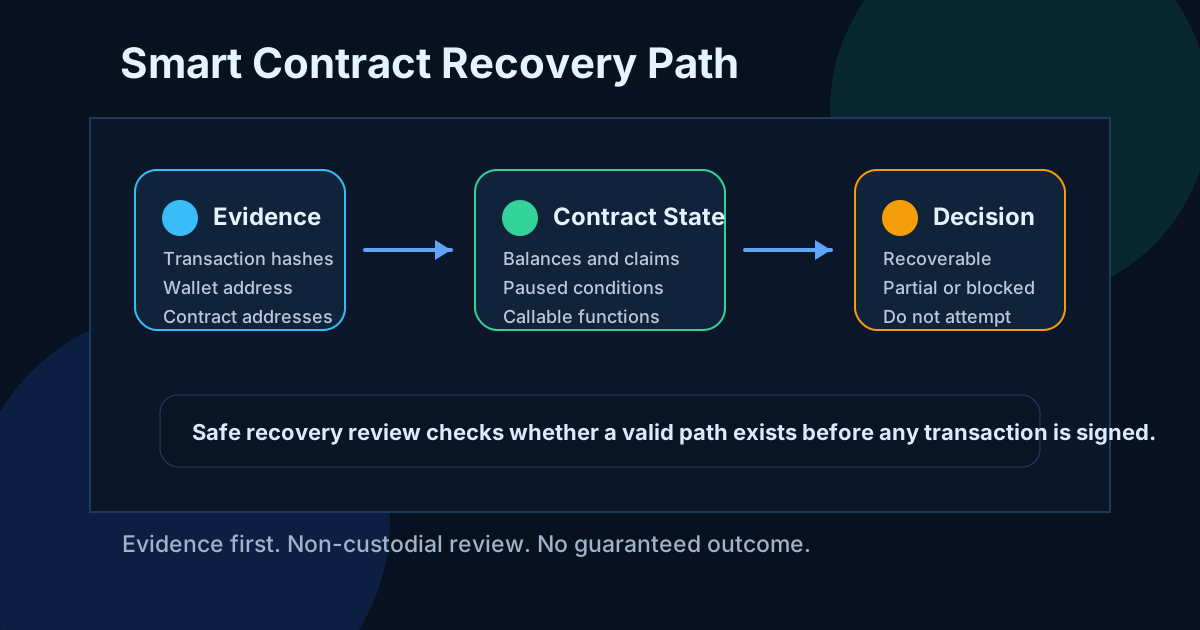
Summary: Smart contracts can sometimes help recover access to DeFi assets when the asset still exists, the user has a recorded claim, and a valid function path remains available. They cannot reverse theft, override permissions, bypass protocol rules, or guarantee a result.
Quick Answer
Smart contracts can help recover assets only when current on-chain state supports a legitimate path: the asset still exists, the user has a recorded claim, and the relevant contract function can be used safely by the right caller. They cannot undo a completed transaction, bypass permissions, recreate a missing claim, or recover funds from a contract that no longer controls the asset.
The phrase smart contract recovery sounds powerful. It also causes confusion. Some users imagine a technical team can reverse a blockchain transaction. Others assume any asset locked in a contract is gone forever. The truth sits between those extremes. Smart contract recovery is possible in some cases, impossible in others, and unsafe when the proposed path ignores contract state or asks for sensitive wallet control.
A useful recovery review starts with a narrow question: what does the blockchain currently say about the asset, the user, and the contract? If a contract still holds assets, records the user's position, and exposes a valid exit, claim, redeem, withdraw, migrate, or emergency function, a recovery path may exist. If the asset is gone, the user claim is not recorded, or the only available action would violate permissions or create new risk, the correct answer may be to document the loss rather than sign another transaction.
This article explains what smart contract recovery really means, what it cannot do, and how to classify a stuck DeFi asset case before taking action. It is written for users who see funds trapped behind a failed website, a broken dashboard, a paused protocol, a migration problem, a vault share mismatch, or an unclear withdrawal route.
Core Recovery Hub Path
This page is the Core Recovery hub for smart contract recovery. Use it to decide whether a case deserves deeper contract-state review, then move to the support guide that matches the evidence you already have.
| If your question is | Use this next | Why it helps |
|---|---|---|
| Are my assets gone or just hidden by a broken interface? | Crypto asset status triage | Separates lost, stuck, pending, and misread positions before contract review. |
| What evidence should I collect before asking for help? | Block explorer fund tracking | Builds the transaction, token flow, contract, and position evidence needed for review. |
| Which contract function might matter? | Smart contract function basics | Explains withdraw, claim, redeem, and emergency-style function concepts without asking you to sign. |
| Should I interact through Etherscan? | Etherscan withdrawal caution guide | Shows why read-only inspection should come before any write-contract action. |
| Do I need a technical review? | Recovery services or case evaluation | Uses public addresses, hashes, contracts, and a timeline; never seed phrases or private keys. |
What Smart Contract Recovery Really Means
Smart contract recovery is the process of using public on-chain evidence and contract behavior to understand whether inaccessible assets still have a legitimate path out. The work is closer to technical diagnosis than to rescue theater. It does not begin with a script. It begins with evidence.
The reviewer checks the original transaction, the receiving contract, emitted events, token transfers, current balances, stored positions, approvals, paused states, access controls, upgrade history, and recent successful exits. The goal is to determine whether the user's problem is caused by an interface failure, a contract-state condition, a misunderstood position token, a migration, or a true lack of recoverable claim.
For example, a DeFi website may disappear while the contract remains live. A dashboard may show zero because the user holds vault shares rather than the original token. A withdrawal button may fail because the front end no longer formats the transaction correctly. A bridge may require a second transaction on another chain. A protocol may pause normal exits while allowing a controlled emergency withdrawal. These are the types of situations where contract-level review can matter.
The phrase recovery can therefore mean several different things. It may mean identifying the correct contract function when a front end is gone. It may mean confirming a claim before a user contacts support or governance. It may mean finding that a direct interaction is possible, but risky. It may also mean explaining that the case is not recoverable under current contract rules.
For a first triage process before deeper review, read the related guide on how to tell if crypto assets are really lost. That article focuses on the initial asset-status question. This article focuses on the smart contract recovery boundary.
What Smart Contract Recovery Cannot Do
Smart contracts are deterministic systems. They execute logic based on current state, permissions, and the transaction input. A recovery reviewer cannot force a contract to ignore its own code. They cannot change past blocks. They cannot unlock assets that the contract no longer controls. They cannot create a user claim that was never recorded. They cannot safely bypass owner-only restrictions unless the contract itself exposes a legitimate path for the relevant caller.
This is the most important boundary. Good recovery analysis does not promise outcomes before reading the contract state. If someone claims they can recover every locked DeFi asset, they are either oversimplifying the problem or creating risk for the user.
| Claim | Reality | User risk |
|---|---|---|
| We can reverse the transaction. | Public chain history cannot be rewritten by a recovery service. | False expectations and possible scam exposure. |
| Share your seed phrase so we can inspect the wallet. | Public addresses and transaction hashes are enough for initial review. | Total wallet compromise. |
| Any stuck contract can be drained back to you. | A valid claim and function path must exist. | Signing unsafe transactions or wasting fees. |
| Copy this successful transaction from another user. | DeFi calls are state-dependent and address-dependent. | Failed transactions, changed state, or loss of remaining claims. |
Recovery is also not the same as hacking a protocol. If a contract restricts a function to an admin, guardian, multisig, or specific role, a normal user cannot simply call that function because it would be helpful. If the contract is paused, a user needs to understand whether the pause blocks their path or whether a separate recovery function exists. If the asset has already been withdrawn, bridged, transferred, liquidated, or swapped, the problem is no longer a stuck contract problem.
Cases That May Be Recoverable
Some cases deserve deeper smart contract recovery review because they still have strong on-chain signals. The asset may still be held by a contract. The user's wallet may still have a receipt token, LP token, vault share, NFT position, internal balance, or event history that maps to a claim. The contract may still expose a relevant function. Recent transactions may show similar exits. The failure may be in the website, not in the contract.
Common scenarios include abandoned yield farms where the front end is offline, staking contracts that still track balances, old vaults after a protocol migration, LP positions hidden behind a broken dashboard, bridge claims that require manual completion, claim contracts with unavailable interfaces, and withdrawal queues where the user does not understand the next step.
| Scenario | Why recovery may be possible | What must be checked |
|---|---|---|
| Front end is offline | The deployed contract may still be callable. | Correct contract, function signature, state conditions, and current balances. |
| User holds vault shares | The original asset may be represented by a share token. | Share balance, exchange rate, redeem function, and vault solvency. |
| Protocol migration failed | Old contracts may still expose exit or claim paths. | Migration rules, user eligibility, deadline, and admin status. |
| Contract is paused | Some protocols pause deposits while allowing exits or emergency functions. | Pause scope, role restrictions, and whether user exits remain allowed. |
| Bridge claim is pending | The user may need a second transaction or proof completion. | Source event, destination contract, message status, and replay risk. |
These examples do not guarantee recovery. They justify careful review. A vault share is only useful if the vault still supports redemption and has assets to satisfy the claim. A callable function is only useful if the caller is allowed, the parameters are correct, and the current state will not cause a harmful side effect. A recent successful withdrawal by another address is useful evidence, but not proof that the same path applies to every user.
If the case involves reading or using a block explorer directly, compare the function-level concepts with the Etherscan withdrawal guide and the primer on understanding smart contract functions.
Recovery Possibility Matrix
A structured recovery review should classify the case before any transaction is signed. The classification should be based on current evidence, not hope. Use this Recovery Possibility Matrix to decide whether the next step is contract-state review, evidence collection, support escalation, or stopping.
| Recovery level | Evidence that supports it | Red flags that weaken it | Responsible next step |
|---|---|---|---|
| Likely recoverable | Asset exists, the user's claim is recorded, the function path is public, and matching exits have succeeded recently. | None of the needed checks depend on private keys, owner-only roles, or copied transactions from another wallet. | Prepare a low-risk execution plan, simulate when possible, and review transaction data before signing. |
| Partially recoverable or conditional | Some evidence supports a claim, but queues, pause states, solvency, bridge status, or migration rules still apply. | The interface says one thing while contract state, logs, or protocol docs are incomplete or stale. | Document constraints, gather missing explorer evidence, and avoid forcing an action before conditions are clear. |
| Unsafe to attempt | The only proposed route requires broad approvals, unknown contracts, secret credentials, remote wallet control, or an unexplained script. | The reviewer cannot name the contract, function, caller permissions, or current state that supports the path. | Stop, revoke unnecessary approvals if appropriate, preserve evidence, and do not sign the proposed transaction. |
| Not enough information | The case is missing a transaction hash, chain, token contract, recipient contract, wallet address, or timeline. | Screenshots and wallet balances are being treated as proof without public on-chain evidence. | Collect public evidence with a block explorer before any recovery decision. |
| Probably not recoverable through the contract | The asset no longer sits in the relevant contract, no user claim is recorded, and no valid callable path applies to the wallet. | Someone still promises guaranteed recovery but cannot explain how the current contract state supports it. | Document the finding and avoid paying for speculative or custodial recovery attempts. |
The best reviews are conservative. If the evidence does not support a path, the answer should say so. If a path exists but carries execution risk, the user should understand what could fail and what state could change. The goal is not to make every case look solvable. The goal is to reduce uncertainty and avoid making a bad situation worse.
What Safe Non-Custodial Review Looks Like
A safe smart contract recovery review should not require a seed phrase, private key, wallet file, remote desktop session, or unlimited token approval. The initial review can usually be done from public data: wallet address, transaction hash, token contract, protocol contract, network, screenshots for context, and a short timeline of what the user tried.
Non-custodial review means the user remains in control of the wallet. The reviewer may explain contract state, identify function paths, prepare a transaction plan, or advise against action. The user should still verify what they are signing. For higher-risk cases, the safer answer may be to test read-only calls, simulate when possible, check recent transactions, and use a fresh environment rather than rushing through a pop-up.
At ContractRescue, this is why the DeFi recovery service starts with scope and evidence. A case evaluation should explain what is visible on-chain, what remains uncertain, which contracts are involved, whether a user claim appears to exist, and what risks apply before any execution step is considered.
Users should also keep expectations realistic. A contract-level review can uncover a path, but it cannot guarantee that the path will remain available, that gas costs will be acceptable, that a protocol admin will respond, or that a drained contract can satisfy a claim. Responsible recovery work includes saying no when the chain data does not support safe action.
Dangerous Recovery Claims to Avoid
Recovery scams often exploit urgency. They contact users after a public complaint, promise guaranteed results, and ask for wallet access. They may use technical language such as smart contract, validator, node sync, bridge unlock, or private recovery tool without showing how the specific contract state supports the claim.
Slow down if someone asks for a seed phrase, asks you to import a wallet into an unknown app, sends a transaction that grants unlimited approval, refuses to identify the contract being called, or claims a fee is required before any on-chain review. A legitimate review can explain the public evidence. It can also explain limits.
The most useful question to ask is simple: what exact on-chain fact supports this recovery path? If the answer is vague, or if the path depends on secrecy rather than verifiable contract behavior, do not sign.
FAQ
What does smart contract recovery mean
Smart contract recovery means reviewing public on-chain evidence, contract state, balances, permissions, and available function paths to determine whether inaccessible assets still have a valid and safe exit route. It does not mean reversing the blockchain or forcing a contract to ignore its rules.
Can a smart contract recover assets from every DeFi protocol
No. Recovery depends on the contract's current state, whether assets still exist, whether the user has a recorded claim, whether functions remain callable, and whether any attempted action is safe. Some cases are recoverable, some are only partially recoverable, and some should not be attempted.
Is smart contract recovery non-custodial
A safe review should be non-custodial. Users should not share seed phrases, private keys, or wallet control. The useful inputs are public wallet addresses, transaction hashes, contract addresses, and a clear timeline.
When is smart contract recovery impossible or unsafe
It may be impossible or unsafe when the contract no longer holds the asset, the user's claim is not recorded, the needed function path is disabled or restricted, the contract is malicious, or the only proposed action requires excessive permissions or sensitive credentials.
Conclusion
Smart contracts can help recover assets only when the contract state supports a legitimate path. The strongest cases usually have visible assets, a recorded user claim, a callable function, and recent evidence that similar exits work. Weak cases lack one or more of those signals. Dangerous cases ask the user to trust a promise instead of public evidence.
The truth is simple: smart contract recovery is not magic, but it is not fiction either. It is a disciplined process for reading what the chain says, classifying the situation, and deciding whether action is safe. If the evidence supports a path, recovery may be possible. If it does not, the safest result may be a clear explanation of why not.
Need a Smart Contract Recovery Review
Prepare the public wallet address, transaction hash, contract address, chain, and timeline. Do not share seed phrases or private keys.
Request Case EvaluationReview Recovery Services
A review can explain contract state and risk boundaries. It cannot guarantee that every stuck asset has a valid exit path.

About the Author: Carlos Vendrell
Last updated: