
Stablecoin Depeg Checklist: xUSD, deUSD, USDX Review
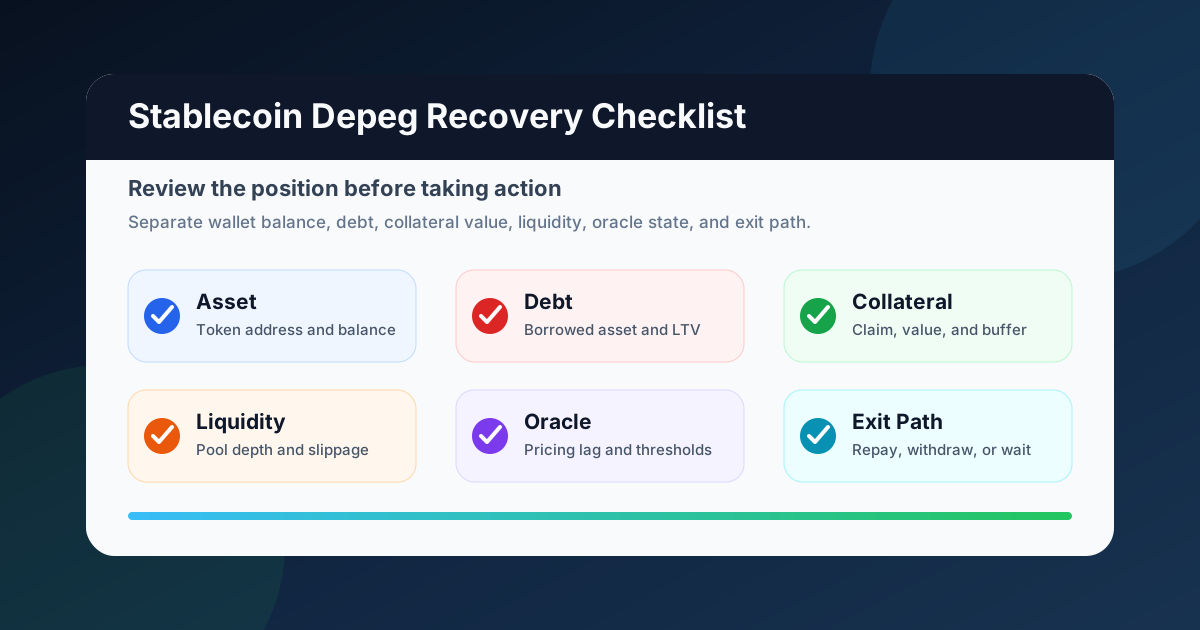
Start here: Do not treat every stablecoin depeg query as the same incident. xUSD, deUSD, and USDX point to different issuers, contracts, redemption paths, and lending exposures. The first job is not to guess whether to repay or sell. The first job is to identify which asset you hold and where it sits.
What This Page Is
This page is a field checklist for users who find themselves exposed to a depegged or stressed stablecoin through a wallet balance, LP position, lending market, vault, or repayment workflow. It is not a price forecast, legal advice, investment advice, or a claim that any token will recover.
The current search demand behind this page includes USDX, xUSD, and deUSD. Those names should not be merged casually. Public reporting describes xUSD as tied to Stream Finance, deUSD as tied to Elixir exposure and redemptions, and USDX as a separate Stable Labs incident. Before making any decision, confirm the token contract, chain, issuer, redemption status, and the protocol where your exposure sits.
If you are only looking at a wallet price chart, you are missing the parts that decide the outcome: whether redemptions are open, whether liquidity is deep enough for your size, whether the asset is collateral or debt, whether a lending oracle has moved, and whether a contract path is still callable.
xUSD, deUSD, and USDX Source Notes
The table below summarizes the source-checked facts that matter before using this checklist. Treat them as starting points for verification, not as a substitute for current project announcements and on-chain data.
| Asset / query | What public reporting says | Do not assume |
|---|---|---|
| xUSD / Stream Finance | CCN reported that Stream Finance disclosed an approximately $93M loss tied to an external fund manager, paused deposits and withdrawals, and left holders dependent on secondary-market liquidity while redemption access was unavailable. | Do not assume a visible market price equals redeemable value, or that a generic stablecoin recovery path applies. |
| deUSD / Elixir | Cryptonews and CoinCentral reported that Elixir halted or retired deUSD support after Stream's loss, processed compensation/redemptions for many holders, and described Stream-related exposure involving deUSD supply and debts to Elixir. | Do not assume every holder, LP, lending-market user, or cross-chain holder has the same claim process or timing. |
| USDX / Stable Labs | OKX reported a USDX depeg to $0.3736 and partial recovery to $0.6159, with a reported link to Balancer V2 Vault disruption and a Stable Labs restoration arrangement involving snapshots. | Do not use USDX numbers for xUSD or deUSD. Verify Stable Labs statements and current market data before relying on any figure. |
Build the Position Map
Write down the chain, token contract, wallet address, protocol contract, transaction hash, and interface used. Then mark the exposure type. This is where generic advice becomes useful or useless.
| Exposure | The real question | Evidence to collect |
|---|---|---|
| Wallet holding | Can this token still be redeemed or sold at practical size? | Issuer update, token contract, pool depth, route quote, holder claim process. |
| Collateral | What oracle price controls borrow capacity and liquidation? | Lending market, oracle address, LLTV or liquidation threshold, health factor, collateral amount. |
| Debt | Does repayment reduce risk or release unusable collateral? | Borrowed asset, debt shares or assets, repayment token, dust risk, collateral withdrawal path. |
| LP or vault share | What is inside the share and is exit queued, paused, or imbalanced? | Pool composition, share price, withdrawal queue, AMM imbalance, protocol announcement. |
Morpho Repayment Details
When the exposure involves a Morpho lending market, the practical issue is not only whether to repay. It is how the debt is represented and what collateral is released afterward. Morpho's own developer documentation distinguishes loan-token assets from borrow shares. For full repayments, Morpho recommends using the user's exact borrowShares balance to clear the debt and avoid residual dust; collateral supply and withdrawal are handled in assets.
That detail matters during a depeg. A user can repay strong collateral or USDC-style debt and receive collateral that is technically withdrawable but economically hard to exit. A transaction that clears debt is not automatically a good recovery if the returned collateral has no redemption path, a frozen issuer process, thin liquidity, or a stale oracle mismatch.
The minimum Morpho review is: market params, collateral token, loan token, oracle, LLTV, current borrow shares, expected borrow assets, collateral amount, health factor, and whether repay-then-withdraw is atomic or separate. If any of those fields are unknown, do not copy another user's repayment transaction.
Decision Checks
Use these checks before repaying, swapping, withdrawing, waiting, or asking for technical review.
| Check | Why it matters | Stop if |
|---|---|---|
| Issuer status | Redemption, claims, snapshots, or compensation rules can change the right action. | You only have screenshots from social media or a copied rumor. |
| Secondary liquidity | A chart price may be based on small trades and not your position size. | The quote changes sharply at the amount you need to exit. |
| Protocol oracle | Liquidation and borrowing depend on the protocol's price source, not the chart you prefer. | You cannot identify the oracle or liquidation threshold. |
| Repayment output | Repaying may release collateral that cannot be redeemed or sold. | You cannot describe what asset comes back after repayment. |
| Signer safety | Depeg events attract fake recovery links and copied transaction scams. | The workflow asks for a seed phrase, private key, remote access, or broad approval. |
What to Document
Good documentation makes later review faster and safer. Keep public information only: wallet address, transaction hashes, chain name, token contract, protocol contract, screenshots of position values, oracle or dashboard timestamps, and notes about actions already attempted. Do not share seed phrases, private keys, wallet files, exchange logins, or remote access.
If you ask for help, describe the position in one paragraph: what stablecoin is involved, where it sits, what debt or collateral exists, what action you are considering, and what evidence is uncertain. A reviewer should be able to explain the current contract state, not just tell you to sign a transaction. For broader recovery boundaries, compare this with what smart contract recovery can and cannot do.
Sources Checked
- CCN: Stream Finance's xUSD Depeg Explained
- Cryptonews: Elixir Halts Support for deUSD After Stream Finance's $93M Loss
- CoinCentral: Elixir Retires deUSD Stablecoin After Stream Finance's $93M Loss
- OKX: USDX Recovery Peg and Depeg Context
- Morpho Docs: Supply Collateral, Borrow, Repay, and Withdraw Collateral
FAQ
Are xUSD, deUSD, and USDX the same depeg case
No. Search results often group them together, but they refer to different assets and different exposure paths. xUSD is tied to Stream Finance, deUSD to Elixir exposure and redemptions, and USDX to separate Stable Labs reports. Verify the exact contract and issuer before acting.
What matters most when redemptions are paused
When redemptions are paused, the market price may be set by secondary-market liquidity rather than a direct redemption path. Users should verify official redemption status, pool depth, and whether their asset is a direct holding, LP share, collateral, or debt position.
Should I repay a Morpho loan immediately during a depeg
Not automatically. Morpho repayment may reduce debt, but it can also release collateral that is hard to sell or redeem. Full repayments should account for borrow shares, debt dust, collateral liquidity, oracle state, and withdrawal sequencing.
What information is safe to share for review
Use public wallet addresses, transaction hashes, token contracts, protocol contracts, screenshots, and a short timeline. Do not share seed phrases, private keys, wallet files, exchange logins, or remote access.
Need a Depeg Position Review
Prepare the public wallet address, transaction hash, token contract, protocol contract, chain, and a short timeline. Do not share seed phrases or private keys.
Request Case EvaluationReview Recovery Services
A review can explain debt, collateral, oracle, and exit-path risk. It cannot guarantee a price recovery or a successful outcome.

About the Author: Carlos Vendrell
Last updated: